
TL;DR

Get beauty and skincare favorites delivered free with Prime
- Fast, free delivery on millions of items
- Prime Video, Amazon Music and more included
- Member-only deals all year
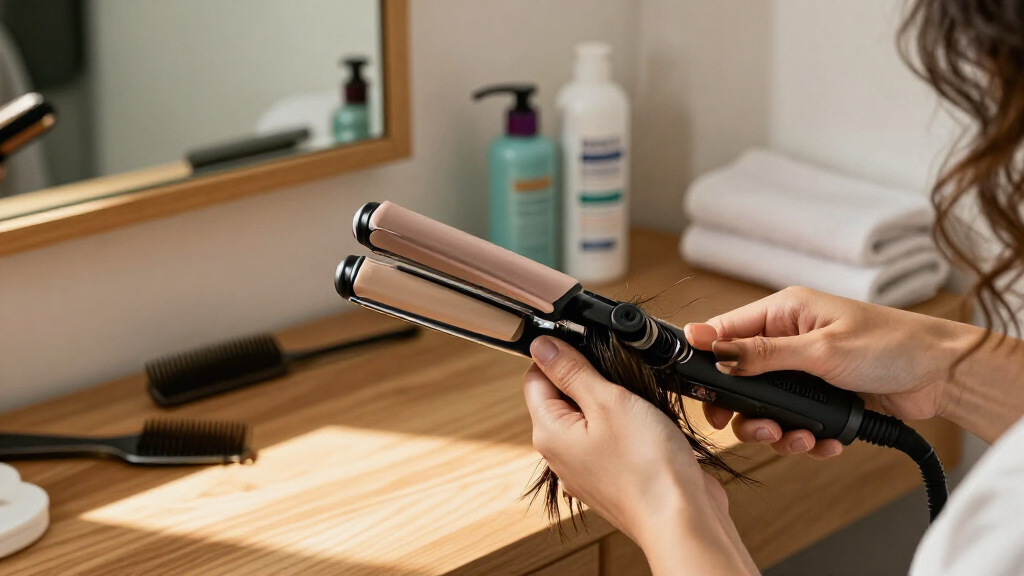
Who What Wear’s beauty writer tested GHD Sculpt, a flat iron that uses a machine-learning model to adjust heat as it senses hair during styling, for 40 days. The reviewer reported quicker styling and useful results across several looks, while claims of five-times-faster styling and zero heat damage come from GHD and its studies, not independent testing described in the review.
Who What Wear’s beauty writer tested GHD Sculpt for 40 days, reporting that the flat iron smoothed frizz, shaped waves and straightened dense, wavy-curly hair in sessions lasting up to 15 minutes. The device uses a machine-learning model to adjust heat during each pass; its maker’s claims that it styles five times faster and causes zero heat damage are not independently established by the review.
GHD describes Sculpt as its first interactive styler. Unlike flat irons that focus on keeping plate temperature even, it measures aspects of the hair and the user’s movements, then adjusts heat during styling. The model can process 2,900 measurements per second, according to the product explanation in Who What Wear’s report, and the temperature can reach up to 365°F.
GHD senior national education manager Meredith Kirkland said the device detects when hair is between the plates, the section’s thickness, the tool’s rotation and the time taken to complete a pass. That information feeds a continuous control process. Kirkland said the tool is not literally thinking: its trained model uses information about different hair types to select a styling temperature.
The reviewer said Sculpt worked on several tasks over the 40-day test, including smoothing crown frizz, defining curls around the face and straightening the hair. Styling took no more than 15 minutes in the reviewer’s account; one finished look reportedly took five minutes. The review also praised the lightweight design and narrow, one-inch plates, which the writer found useful for getting close to the roots and making waves.
What Heat Adjustment Could Change
Flat irons typically manage heat by maintaining an even plate temperature. GHD’s approach instead aims to adjust heat in response to the hair and the way the tool is being used. If that works consistently, it could make one device more adaptable across sections and styling techniques, rather than relying on a fixed setting.
For shoppers, the distinction between reported styling performance and manufacturer damage claims matters. The reviewer’s account offers a practical example of how the tool performed for one person with dense, frizz-prone, wavy-curly hair. It does not establish that the same timing or results will apply to other hair types, users or routines.
Products Worth Considering

Withings Body Scan Smart Scale with Segmental Body Composition and ECG, Black
Withings Body Smart Wi-Fi and Bluetooth Smart Scale

Levoit Vital 200S-P Smart Air Purifier for Large Rooms
As an affiliate, we earn on qualifying purchases.
How GHD Describes the Technology
GHD says Sculpt’s algorithm was trained using an array of hair types and styles. In the company’s description, the tool reads several signals during each pass and adjusts heat up to 365°F. The system’s settings are not saved as a lasting personal profile: Kirkland said Sculpt forgets the information when it is switched off, so another person can use it with the process starting again.
The company also claims the device delivers five-times-faster styling and zero heat damage. The review reports that GHD’s clinical studies found no statistically significant differences between untreated hair and hair styled with Sculpt, and that styled hair returned to its natural structure after washing. These are company-reported findings; the supplied article does not provide the study design, sample size or independent replication details.
What the Test Cannot Establish
The report is a single reviewer’s experience, not a controlled comparison of Sculpt with other flat irons. It does not establish whether the speed or styling results generalize to users with different hair textures, lengths or techniques. The supplied source also does not give enough information to independently evaluate GHD’s clinical claims about damage, including the study sample, methods and comparison conditions.
The reviewer’s positive results do not prove that heat styling is risk-free. The report does not establish long-term effects from repeated use across a wider group of people, nor does it show whether the device’s adjustments can be verified by users while styling. GHD’s five-times-faster figure likewise lacks a comparison baseline and test details in the supplied material, so it should be treated as a company claim rather than a confirmed result of the 40-day review.
More Evidence Needed on Damage
The review provides no announced follow-up testing or independent clinical study. Readers weighing the product’s claims can look for published study methods, details about the comparison group and tests conducted by researchers outside the company. Until those details are available, the clearest evidence here is limited to the reviewer’s reported experience and GHD’s own description of how Sculpt operates.
Key Questions
What is GHD Sculpt?
It is a flat iron that GHD says uses a machine-learning model to adjust heat as it detects hair and measures the styling process.
How did it perform in the 40-day review?
The Who What Wear reviewer reported using it to smooth frizz, define curls and straighten hair. The writer said styling took up to 15 minutes, with one look taking five minutes; those results reflect one person’s experience.
Does GHD Sculpt cause zero heat damage?
GHD claims zero heat damage and cites its own clinical studies. The supplied report does not include enough study information to verify that claim independently, so it should not be treated as established for every user or use pattern.
Does the flat iron save a user’s hair profile?
According to GHD education manager Meredith Kirkland, Sculpt resets when powered off. The company says it starts assessing the hair again when the tool is used next, including by another person.
Source: rss