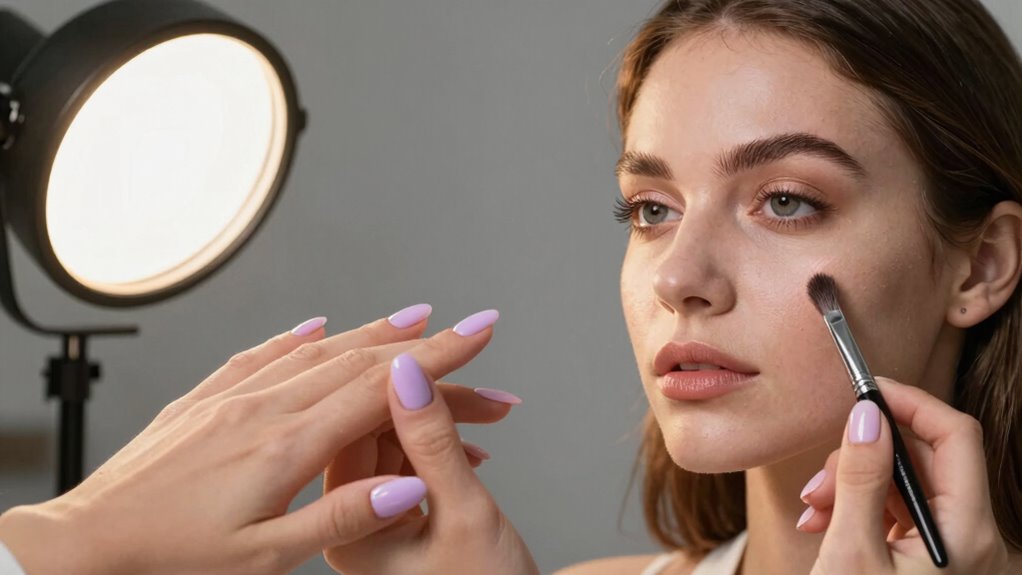

You shouldn’t set your nail and makeup lighting the same way because each craft needs different angles, intensities, and color temperatures to look flawless. For makeup, you want even front or overhead lighting in the 5000K-6500K range to mimic natural daylight and show true shades. For nails, use direct, close-up lighting between 4000K-5000K to see fine details clearly. Adjusting your setup for each task helps you achieve professional results—keep exploring to learn more.

Get beauty and skincare favorites delivered free with Prime
- Fast, free delivery on millions of items
- Prime Video, Amazon Music and more included
- Member-only deals all year
Key Takeaways
- Makeup lighting should be positioned in front or slightly above the face to ensure even, shadow-free illumination.
- Nail lighting needs to be directly above or to the side to clearly illuminate small details and prevent glare.
- Makeup requires a color temperature around 5000K to 6500K for true skin tone and color accuracy, unlike nails which prefer 4000K to 5000K.
- The lighting setup for makeup emphasizes soft, frontal light, while nail lighting focuses on direct, focused illumination of workspace.
- Proper positioning and color temperature differ to optimize visibility and precision for each craft.
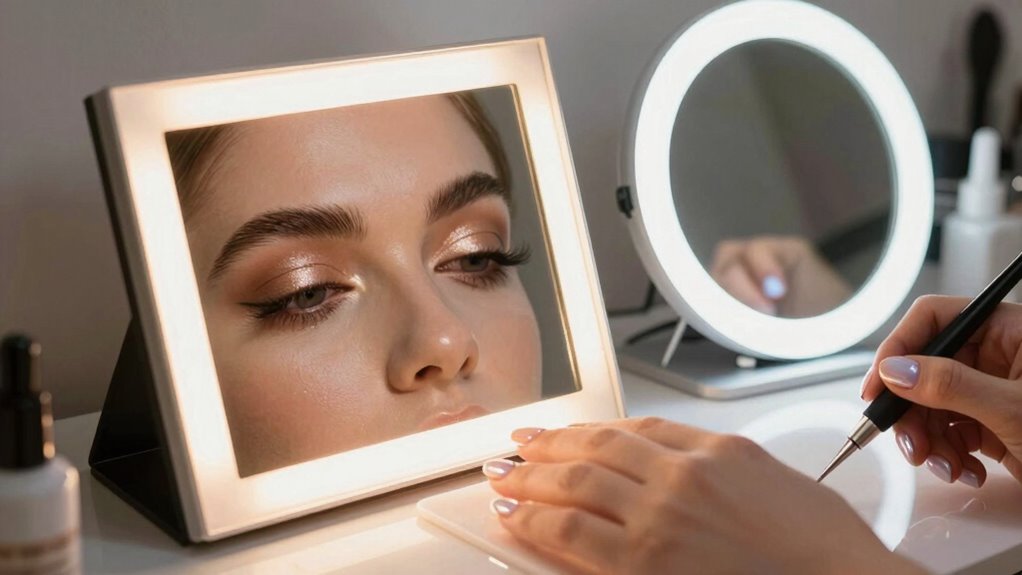
Good lighting is vital when working on nails or makeup because it guarantees you see every detail clearly. The way you set up your lighting can make a significant difference in the quality of your work. While it might seem convenient to use the same lighting setup for both nails and makeup, doing so can lead to less-than-ideal results. The key lies in understanding the importance of color temperature and light positioning, which vary depending on whether you’re doing nails or makeup.
Color temperature plays an important role in how you perceive colors under different lights. For makeup, you want a light source with a color temperature around 5000K to 6500K, which mimics natural daylight. This helps you see the true shades of foundation, eyeshadow, or lipstick without distortions caused by overly warm or cool lighting. Cooler lights tend to enhance detail and contrast, making it easier to blend makeup seamlessly. Conversely, when working on nails, a slightly warmer or neutral light (around 4000K to 5000K) can help you see the true color of polish or designs without the glare that sometimes comes with cooler, bluish tones. If your lighting is too warm, it might skew the colors, leading to mismatched shades or uneven finishes. Proper lighting setup is also crucial for reducing eye strain during long sessions.
Light positioning is just as important. For makeup, you want your light source to be positioned in front of or slightly above your face, ensuring even illumination without harsh shadows. Proper placement minimizes shadows under your eyes or chin, giving you a clear view of your skin’s tone and makeup application. It’s best to avoid placing the light directly overhead or behind you, which can create unflattering shadows or wash out your features. When working on nails, you need a different approach. Position your light directly above or slightly to the side of your workspace, so you can clearly see small details and intricate designs. You also want the light to be close enough to illuminate your work without causing glare or reflections that obscure your view.
In essence, you shouldn’t set your lighting the same way for nails and makeup because each task demands specific conditions to achieve the best results. Adjusting color temperature ensures colors look accurate, whether you’re blending makeup or matching nail polish. Proper light positioning helps you see fine details clearly, preventing mistakes and ensuring your work looks polished. Additionally, understanding the importance of lighting can help you create a more professional finish in both makeup and nail art. By fine-tuning these elements and considering lighting ergonomics, you give yourself the best chance to succeed in both nail art and makeup application, making your efforts more precise and professional.
Products Worth Considering

Oura Ring 5 Smart Ring – Silver – Size 10

Oura Ring 4 Smart Ring – Silver – Size 8

Bowflex SelectTech 840 Adjustable Kettlebell
As an affiliate, we earn on qualifying purchases.
Frequently Asked Questions
Can I Use the Same Lighting Setup for Both Nails and Makeup?
You shouldn’t use the same lighting setup for nails and makeup because lighting consistency differs for each. Makeup requires soft, even light to avoid shadows and show true colors, while nail lighting needs brighter, focused illumination to highlight details. Guarantee your equipment is compatible with these needs. Adjust your lighting angles and intensities accordingly, so each task gets ideal visibility without compromising the overall look or workflow.
What Color Temperature Is Ideal for Nail Lighting?
The ideal color temperature for nail lighting is around 5000K to 6500K, which offers a neutral, daylight-like tone. This range guarantees accurate color representation and consistent lighting, helping you see true nail colors and details. Sustaining this color temperature promotes lighting consistency, so your nail work looks professional and even under different conditions. Avoid warmer or cooler tones, as they can distort colors and affect your precision.
How Does Lighting Impact the Accuracy of Color in Makeup?
Lighting directly impacts how accurately you see makeup colors. When your lighting is well-calibrated, it guarantees color consistency, helping you pick shades that look true to life. Coincidentally, this means your makeup application matches your vision, avoiding surprises. Proper lighting calibration eliminates color distortion, so you can trust what you see. Ultimately, good lighting enhances your precision and confidence, making your makeup flawless and true to your intended look.
Are There Specific Light Types Recommended for Nail Artistry?
For nail artistry, you should choose lighting with LED bulbs that offer high color rendering. This type of lighting accurately displays true nail colors, making your work precise. Look for lights with a high Color Rendering Index (CRI), ideally above 90, to guarantee colors appear natural and vibrant. Good lighting helps you spot imperfections and ensures consistent, professional results, enhancing your overall quality and client satisfaction.
How Can I Adjust Lighting to Reduce Shadows on the Face?
A little light goes a long way—especially when it’s about reducing shadows. You should use diffused lighting to soften harsh shadows on your face, placing it at eye level or slightly above. Natural light is ideal, so try to position yourself near a window during the day. Avoid direct overhead lights, and consider adding reflectors or additional soft light sources to evenly illuminate your face.
Conclusion
Imagine walking into a room where the lighting is perfect for reading but terrible for a photoshoot. Just like that, your nails and makeup need different lighting setups to truly shine. I once tried using the same lights for both, only to realize my lipstick looked dull while my nails gleamed. Adjusting each to its ideal conditions is like tuning a musical instrument—you’ll see, and feel, the difference in every detail.